The Songs That Travelled Through 1971
There is something extraordinary about watching Muktir Gaan today. The people inside its grainy images do not yet know how their story ends.
They do not know that Bangladesh will achieve victory in December. They do not know which fighters will return, which families will reunite, or what kind of country will emerge from the devastation. They sing, travel, wait for news and speak about freedom while freedom itself remains uncertain.
That uncertainty is the great strength of Muktir Gaan.
Released in 1995, the documentary was directed by Tareque Masud and Catherine Masud, but its images began their journey more than two decades earlier. In 1971, American filmmaker Lear Levin travelled with a musical troupe of Bangladesh Mukti Sangrami Shilpi Sangstha, filming its members as they moved between refugee camps, border areas and camps of freedom fighters. Levin spent several weeks filming them, but his original documentary remained unfinished. Tareque and Catherine Masud later recovered the footage in 1990 and combined it with historical material collected from other archives to construct Muktir Gaan.
The result feels neither like a conventional historical documentary nor simply a collection of songs from 1971. It is closer to a road movie made inside a revolution.
A truck becomes a temporary home. Songs become political speech. Refugee camps become audiences. Newspaper reports arrive like fragments from another world. And an emerging country seems to travel alongside the performers, not yet secure on a map but already alive in their voices.

Before the music comes the rupture
The film first establishes what has been broken.
Archival footage brings us to Sheikh Mujibur Rahman’s historic 7 March speech. His call to turn every home into a fortress gives way to the sound of gunfire and images of people fleeing with children and bundles of belongings.
The transition is violent because history was violent.
Muktir Gaan then moves from the road to diplomatic chambers. In footage from United Nations debates, Indian representative Samar Sen speaks about the millions of refugees who crossed into India. Zulfikar Ali Bhutto speaks for Pakistan. George H. W. Bush, then the United States ambassador to the UN, appears in the diplomatic discussion surrounding the crisis.
The Masuds place these formal political voices against images of displacement. The effect is telling. Inside international institutions, war becomes vocabulary, numbers and diplomatic positioning. Outside, people are abandoning houses, carrying elderly relatives across borders and wondering how they will feed their children.
Then comes archival audio of Major Ziaur Rahman broadcasting the declaration of Bangladesh’s independence on behalf of Bangabandhu Sheikh Mujibur Rahman.
Only after speeches, gunfire, refugees and resistance have collided does the title arrive.
Muktir Gaan.
The songs can now begin.
A truck full of resistance
At the centre of the documentary is Bangladesh Mukti Sangrami Shilpi Sangstha, the cultural organisation formed during the Liberation War under the leadership of cultural figures including Sanjida Khatun and Waheedul Haq. One of its travelling groups moved between refugee camps and areas connected with the resistance, performing patriotic songs and other cultural programmes to inspire refugees and freedom fighters.
Among the cultural activists associated with the troupe and represented in the film are Mahmudur Rahman Benu, Shaheen Samad, Naila Zaman, Lubna Marium, Swapan Chowdhury, Bipul Bhattacharya, Sharmeen Murshid, Debabrata Chowdhury, Lata Chowdhury and Dulal Chandra Shil.
Mahmudur Rahman Benu led the musical team, while Shaheen Samad was among the prominent singers who travelled through refugee camps and liberated areas during the war. Contemporary recollections describe the group performing patriotic songs to encourage both displaced civilians and freedom fighters.
Yet Muktir Gaan never feels like a parade of celebrated names.
The performers exist primarily as a collective.
Their truck becomes one of the film’s most memorable spaces. They eat there, rest there, talk there and travel mile after mile along the border. At one moment, someone reads news about Mukti Bahini operations from a newspaper. At another, conversation turns towards family members fighting inside Bangladesh.
Naila worries about her father. News is uncertain. Elsewhere, there is anxiety about Nadim, a young guerrilla operating inside the country.
These moments are important because the performers are not allowed the luxury of standing outside history. They may be singing for others, but they themselves are living with fear, separation and displacement.
The songs are public. The anxiety between songs is deeply private.
When music becomes action
The most distinctive achievement of Muktir Gaan is the way it refuses to treat music as background.
Songs do not simply accompany the Liberation War. They participate in it.
The troupe sings about Bengal’s rivers carrying blood, about farmers and workers overcoming fear, about loss and sacrifice, and about a country that must be liberated. Before refugee audiences, music turns individual suffering into something collective. At training camps, it becomes encouragement for young men preparing for combat.
One sequence moves between the singers and recruits practising with dummy rifles. The contrast could not be clearer. One group is preparing bodies for war. The other is strengthening the imagination that makes sacrifice meaningful.
The documentary never claims that a song and a rifle perform the same task. It suggests something more interesting: wars are not sustained by weapons alone.

People need a language for what they are defending.
One of the songs heard in the film moves through Jessore, Khulna, Bogra, Pabna, Dhaka, Barisal and Noakhali before declaring that the people being invoked are neither Hindu nor Muslim, but Bengali.
The lyric reveals the political heart of Muktir Gaan. Its Bangladesh is imagined through a secular Bengali cultural identity that refuses communal division.
Culture here is not entertainment after politics. It is one of the places where politics acquires meaning.
The people who listen
Lear Levin’s camera becomes especially powerful when it turns away from the performers.
It watches the audience.
Faces fill the frame. Refugees sit listening to songs about the country they have been forced to leave. Some appear deeply attentive. Others seem exhausted beyond visible reaction. Grief does not always announce itself dramatically.
The film’s accounts from refugee camps are among its hardest passages.
An elderly woman has lost members of her family. Homes have been burned. One refugee explains that the paddy planted before fleeing will simply be harvested by whoever remains to claim it. Another family recounts the death of an elderly man after he continued to say “Joy Bangla” despite being beaten.
A woman carrying a child explains the most immediate consequence of displacement: there is not enough food, so how can she feed the baby milk?
Muktir Gaan constantly moves between enormous numbers and individual lives.
The refugee crisis involves millions, but a number can become abstract. A burnt home cannot. An abandoned crop cannot. An elderly man travelling with a walking stick cannot.
The film therefore brings the scale of history down to human proportion without making the war seem smaller.
The country that exists before the border does
One of the finest images in Muktir Gaan comes when the group travels into liberated territory.
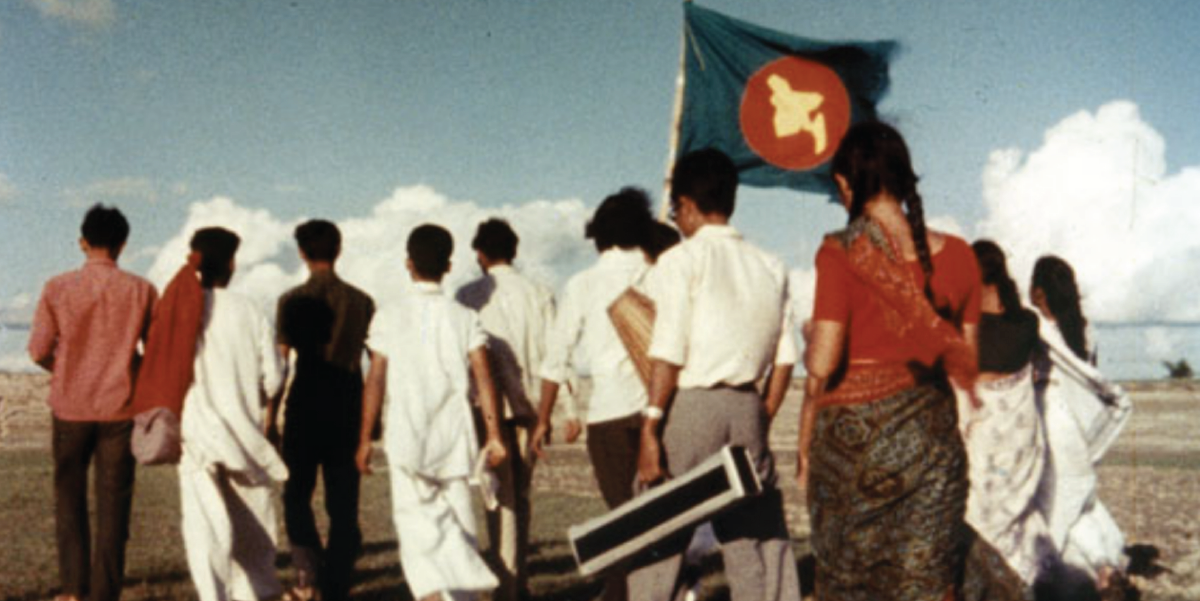
A Bangladesh flag flies near the border. Below it, however, a sign still bears the name “East Pakistan.” Someone appears to have tried to scrape the letters away. Few images in the documentary say more with less.
The new nation exists above. The old state remains underneath.
Political change has happened faster than the physical world can absorb it. The flag can be raised immediately, but signs, institutions and memories cannot be rewritten in a day. The troupe continues its journey through the liberated area, at one point travelling by boat while singing “Amar Sonar Bangla.”
The scene is almost startling in its beauty.
Water, voices, villages and the new flag momentarily create an image of the country that people are still fighting to secure. The Bangladesh of the future seems briefly visible inside the Bangladesh of war.
But the film does not allow that lyricism to become a romantic escape.
Soon the performers are among freedom fighters preparing for military action.
Beside the guerrillas
The presence of Major Giasuddin Chowdhury and his guerrilla fighters changes the film’s rhythm again.
Orders are given. Watches are synchronised. Positions for an operation are discussed. Weapons, passwords and prisoners cease to be abstractions.
The singers have reached the edge where cultural resistance meets armed resistance.
There is something particularly powerful when freedom fighters and cultural activists sing together. The categories begin to overlap. The person holding a rifle can also sing. The singer can also understand the urgency of combat.
The film does not romanticise the distinction away, but it questions the idea that only one form of participation constitutes meaningful resistance.
Bangladesh Mukti Sangrami Shilpi Sangstha travelled through refugee camps and liberated areas precisely because morale mattered. Shaheen Samad later recalled how the group performed patriotic songs and cultural programmes to inspire those living through the war.
Muktir Gaan turns that cultural effort into something visible.
Catherine Masud’s invisible architecture
It is tempting to think of Muktir Gaan as historical footage that simply needed to be discovered.
But recovered material does not automatically become a film.
Its power comes from construction.
The Masuds combine Levin’s footage with speeches, UN debates, battle scenes, radio broadcasts and other archival material. Catherine Masud’s editing gives these fragments rhythm and emotional continuity.
A song may begin in one space and continue across images from another. A political statement can be followed by evidence of what that political language attempts to contain. Music stitches refugees, performers and guerrillas into the same narrative.
The documentary consequently feels less like a chronological lecture about 1971 and more like memory itself. One image leads to another because of emotion, sound or association.
This is also why its rough textures matter.
The black-and-white footage, sudden shifts in visual quality, imperfect sound and archival fragments do not weaken the experience. They remind us that these images survived history before becoming cinema.

Victory does not get the final word
A conventional liberation documentary might naturally build towards December 1971 and stop with triumph.
Muktir Gaan refuses such an easy ending.
The war ends. Bangladesh becomes independent. But the final narration remembers the freedom fighters who did not live to enjoy victory: the young fighter, the elderly farmer, the man with a gamchha around his head, the unnamed martyrs whose lives made independence possible.
Then comes the question that changes the meaning of everything before it.
Is remembering their sacrifice enough?
Can later generations uphold the ideals for which they fought?
That question keeps Muktir Gaan from becoming merely commemorative. The documentary is interested in memory, but it does not believe remembrance alone is an achievement.
Released in 1995, the film later travelled widely through screenings and became one of the best-known cinematic works built around the cultural front of Bangladesh’s Liberation War. The original footage itself has an unusual history: Levin had filmed the troupe for weeks in 1971 but could not complete his planned film, while the Masuds’ recovery of that material allowed those journeys to reach audiences decades later.
And perhaps that distance between 1971 and 1995 is precisely what gives Muktir Gaan its enduring force.
It allows us to look backwards, but the people on screen are always looking forward.
They do not yet possess an independent Bangladesh. They are imagining one.
In their songs, refugee camps briefly become gathering places rather than sites of abandonment. A truck becomes a moving cultural front. A flag flies above the stubborn remains of the words “East Pakistan.” Guerrillas and singers find themselves in the same chorus.
Muktir Gaan does not simply show how Bangladesh won a war.
It preserves the sound of people trying to imagine what freedom should mean before they knew they would live to see it.
And when the final song disappears into silence, the film leaves behind a question more difficult than victory itself: what did they believe they were building, and how faithfully have we carried that belief forward?