Rhymes, Rhythm and a Milestone
Nrityanchal Turns 25
By MWB Desk
An anniversary can tell an institution’s story through speeches, photographs and familiar faces. Nrityanchal’s silver jubilee also told its story through the students taking the stage. More than 400 children and adolescents participated in one evening’s production, while the closing programme brought together senior performers and more than 300 artistes. Across three days at Bangladesh Shilpakala Academy, the celebration connected the dance institution’s past with the generations now participating in its work.
Held from September 11 to 13, the festival marked 25 years of Nrityanchal’s journey. Its programme combined a rally, performances, an inaugural ceremony and an exhibition documenting the institution’s history. At the centre were its two directors, dancers and choreographers Shamim Ara Nipa and Shibli Mohammad. Their presence connected the anniversary’s different elements: the public celebration, the students’ performances and the concluding presentation in which the directors themselves danced.

The festivities began on September 11 with a rally on the Bangladesh Shilpakala Academy premises. Teachers, students and members of Nrityanchal’s production team participated alongside Nipa and Shibli. Following the rally, the two directors formally inaugurated the festival by releasing balloons and festoons. Beginning with this collective gathering gave the anniversary a wider frame than a succession of stage performances. It brought the people involved in the institution’s everyday activities into the opening of its celebrations.
The following evening shifted attention to Nrityanchal’s younger students. At 6:45 pm on September 12, the National Theatre auditorium hosted “Chhoray Chhonde Nrityamala”, a production built around children’s rhymes and educational themes. More than 400 children and adolescents from the institution participated. Nipa directed the choreography, while Shibli oversaw the production. The programme combined rhyme, rhythm, learning and enjoyment, placing familiar material from children’s cultural world within a dance presentation created for the stage.
That choice of material offered an accessible starting point for the young performers’ programme. Rhymes have patterns that can be heard and repeated; dance gives those patterns a physical form. By bringing educational subjects into the presentation, “Chhoray Chhonde Nrityamala” also connected performance with learning. Its significance within the anniversary lay in making children’s participation a substantial part of the celebration. The younger students had a programme of their own, with its own concept and creative direction.
Shama Obaed, State Minister for Foreign Affairs, attended the September 12 programme as chief guest. Bangladesh Shilpakala Academy director general Sheikh Rezauddin Stalin was also present, alongside cultural personalities, journalists, businesspeople and other spectators. Their attendance brought together people from several areas of public life around an evening focused on young dancers, giving the students’ presentation a place within the festival’s broader institutional celebration.
The evening opened with a ceremony involving the tying of nupur, the anklets associated with dance. Participants included Shama Obaed, Sheikh Rezauddin Stalin, Amanul Haque, Kajal Ibrahim, Lubna Marium, Dr Soma Mumtaz, Belayet Hossain Khan and Anisul Islam Hero, together with Nipa and Shibli. The gesture drew the inauguration directly into the language of the art being celebrated. With established dance figures joining the ceremony, it also placed the students’ programme within a wider community of practitioners.
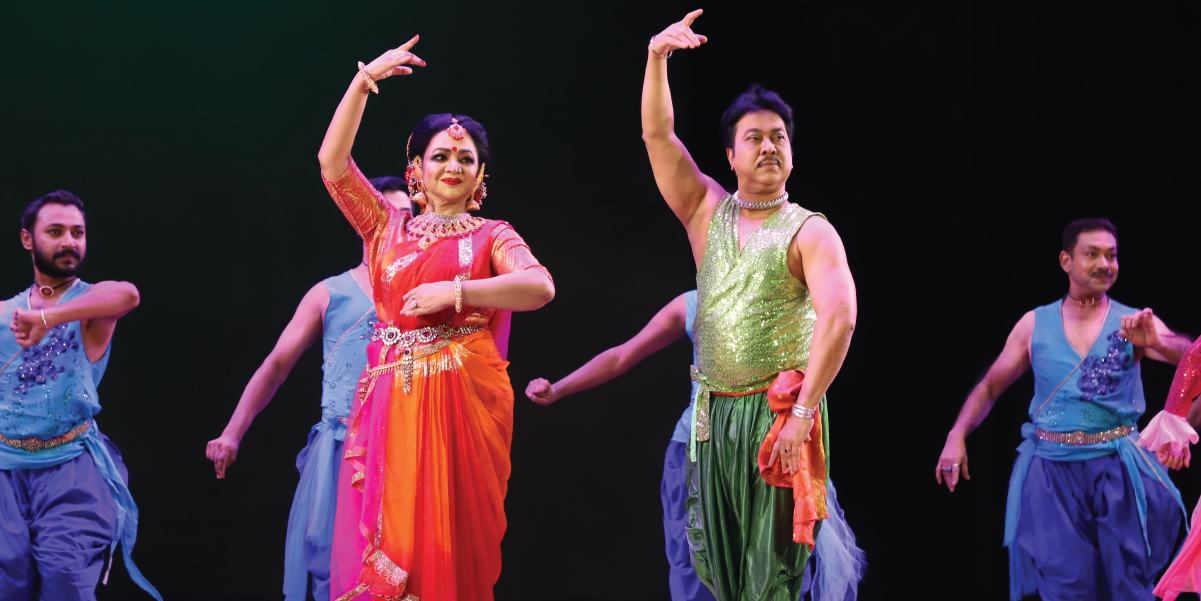
On September 13, the festival concluded with “Nrityamalika”, which began at 6:45pm in the same auditorium. Nitai Roy Chowdhury, Cultural Affairs Minister, served as the chief guest. The closing production combined folk, creative and classical dance, bringing together Nrityanchal’s senior artistes and more than 300 performers. This range gave the concluding evening a different emphasis from the children’s production, presenting several strands of dance practice within one programme.

The combination of forms made the closing presentation an opportunity to consider the breadth of Nrityanchal’s work. Folk, creative and classical dance appeared within the anniversary’s concluding programme, rather than the celebration being organised around a single category. Alongside the previous evening’s use of children’s rhymes, this variety showed the different approaches represented in the festival. The two productions together offered a view of participation across ages and of material shaped for different groups of performers.
A special performance by Nipa and Shibli was among the closing evening’s principal attractions. Throughout the festival, the directors’ roles extended beyond their own appearance onstage. Nipa’s choreography and Shibli’s supervision of the children’s programme were also part of the anniversary. Seen together, these contributions connected their work as performers with their responsibilities within the institution. The celebration therefore gave space to both their artistic partnership and the students whose performances formed much of the programme.


Away from the stage, an exhibition in the National Theatre auditorium’s lobby added a historical dimension. Open on September 12 and 13, it presented photographs and memorabilia covering Nrityanchal’s journey from its beginnings to the present. The displays documented activities, productions, achievements and memorable occasions. They gave visitors another way to engage with the anniversary, allowing the institution’s earlier work to be considered alongside the performances taking place during the festival.
Such an exhibition has a particular value at a dance celebration. A performance unfolds in time, while photographs and preserved objects offer records that can be revisited. Here, the exhibition brought selected chapters of Nrityanchal’s 25 years into the same venue as its current productions. The audience could encounter the anniversary through both live performance and documentation, with each offering a different perspective on the work being celebrated.
Maasranga Television served as the festival’s media partner, with support from Shah Cement. The closing evening also brought together dancers, cultural personalities and arts enthusiasts in the auditorium. Yet the anniversary’s clearest measure was the participation running through its programme: teachers in the opening rally, children in the second evening’s production, senior artistes in the finale and the directors in several roles. Nrityanchal’s silver jubilee made its 25-year history visible through an exhibition, while giving its present work room onstage. That combination gave the milestone both a record of what had been built and a view of the people carrying its dance practice forward.